Policy Pulse: Capacity Building of DepEd in the Implementation of ALS Micro-certification
Marlene Ferido, PhD & Bruce Beswick, PhD
Background
The DepEd Alternative Learning System (ALS) serves as a vital “second-chance” program for out-of-school youth and adults (OSYA), providing flexible pathways to complete basic education. While the curriculum is aligned with formal K-12 standards, the program faces a significant challenge: many learners leave before completion. Data from 2016–2018 shows that while 65% of enrollees completed the Accreditation and Equivalency (A&E) program, only 18% ultimately passed the accreditation exam. Consequently, most learners exit the program without any formal proof of the skills they acquired. To bridge this gap, UNICEF and DepEd commissioned Melbourne Metrics (formerly Melbourne Assessment [2021-2023] and the Assessment Research Centre [1987-2020]) of the University of Melbourne and the UPCIDS Assessment, Curriculum and Technology Research Program (ACTRP) to conduct a study to explore the potential of micro-certification in the ALS to provide opportunities for learners to receive credits or certificates for the extent to which they attain levels of transferable capabilities that employers could highly value.
Micro-certification is the formal recognition of a learner’s achievement in a specific, targeted skill or “unit” of learning, providing them with valuable credentials even if they have not finished a full secondary school program or university degree.
Research Objectives and Scope
This phase of the project (Phase 3) focused on building the capacity of DepEd-Bureau of Alternative Education (BAE) Specialists and micro-certifying over 2,500 ALS learners across eight Schools Division Offices. The study assessed four key life skills: Communication, Teamwork & Cooperation, Leadership, and Problem Solving.
The first phase of the work (2020-2021) involved the development of assessment instruments for two capabilities drawn from the Life Skills modules of the ALS program: Communication and Teamwork & Cooperation. The instruments were piloted with 600 ALS learners and found to produce results with levels of validity and reliability required for micro-certification in the capabilities. This phase was conducted in NCR Manila, Batangas Province (Region IV-A), Davao City (Region XI) and South Cotabato (Region XII) with the participation of the Divisions’ respective ALS learners, teachers, ALS focal persons, Education Program Specialists for ALS and qualified raters for the learners.
The second phase (2023) involved the development of assessment instruments for two more capabilities – Leadership and Problem Solving – which were also piloted with 600 ALS learners and found to produce the results required for micro-certification. This phase was conducted in Aurora (Region III), Misamis Oriental (Region X), Iriga City (Region V) and Lapulapu City (Region VII) with the cooperation of the same types of participants as in Phase 1.
In Phase 3, the assessment of ALS learners was conducted in two rounds, allowing personnel from DepEd-BAE to undergo training in Round 1 and take the lead in Round 2 while continuing to receive advice from the research team.
While the assessment of learner performance primarily involved paper-and-pencil testing, Phase 3 included a small trial of Ruby, which is an online assessment platform developed by Melbourne Metrics. The platform is an end-to-end solution to the assessment of life skills that provides rigorously designed rubrics for assessors to use in recording their judgements on the performances of learners. The data entered by assessors is analyzed by the platform’s software, allowing levels of performance to be assigned to learners.
Methodology: Capacity Building
Collaborative Training
The research team trained BAE Specialists in assessment theory, data collection, and Item Response Theory to ensure they understood the psychometric rationale behind the certifications. The BAE Specialists were trained and equipped to achieve a level of confidence in the theory and practice of the micro-certification model so that they could train the ALS personnel in the Schools Division Offices (SDOs).
Round 1 training conducted by the research team
In Round 1, the Research Team led the data collection process and trained the BAE personnel in the conduct of the assessment of ALS learners. To prepare personnel at all levels for Round 1 of the assessments to be conducted in School Year 2024-2025, three days of orientation and training for BAE and ALS personnel were delivered in Lapu-Lapu City and Davao City. They were attended by BAE Specialists and Chiefs, Regional Focal Persons, Division Focal Persons, EPSAs, ALS teachers involved in the Ruby trial, and representatives of UNICEF from the Mindanao Field Office, along with representatives from two BARMM SDOs, who attended to learn about ALS Life Skills Micro-certification for potential replication in the region.
The training included a step-by-step guide to the assessment process, roles and responsibilities of all participants, the recruitment of learners and community raters, the registration of learners and raters, the distribution and collection of assessment instruments, and the scanning and cleaning of assessment data from the paper-and-pencil assessments. The use of the Optical Mark Recognition software required for the scanning and cleaning of response sheets was demonstrated.
The features of the Ruby platform were demonstrated to all participants, accompanied by a live training version so that participants were able to log into Ruby and practice its use. Most of the participants found the platform easy to use and preferable to paper-and-pencil assessments.
Online introduction to Item Response Theory
To provide a background on Item Response Theory, BAE personnel were provided with two sessions on the data analysis methodology used by the research team’s psychometricians, delivered by Professor Margaret Wu, a renowned expert and author on Item Response Theory (IRT) and the co-creator of two IRT software programs. The sessions focused on the differences between Classical Test Theory and IRT and explored questions arising from the application of IRT. These sessions were designed to help them understand the method of analysis for the results of the micro-certification study.
Round 2 training conducted by BAE Specialists
The DepEd-BAE Specialists needed to acquire sufficient mastery of the theory and practice of the assessment and micro-certification model so that they could effectively train the ALS Focal persons and EPSAs from the four SDOs that would participate in Round 2. The latter would cascade the training to ALS teachers, learners, and nominated raters.
By the second round of capacity building, the BAE Specialists took the lead, successfully training local focal persons and teachers with minimal supervision.
Three BAE specialists conducted the training, which followed the same basic structure as the training they received in Lapu-Lapu City and Davao City. The sessions included the thinking behind the assessment model, a walk-through of the assessment process, and practice on the Ruby platform, with some additional information and activities introduced by the presenters. Observers noted that the additional information and activities were appropriate and that the BAE specialists did well in explaining the material, including the more complex topics such as the development of assessment frameworks.
Training of BAE Specialists in data sorting, scanning and cleaning
As BAE would be taking the lead in the administration of assessments for Round 2, four BAE Specialists observed and received training from a UPCIDS-ACTRP Research Officer in the sorting, scanning and cleaning of the collected Round 1 data using Optical Mark Recognition software. Although the sorting and scanning of Round 2 data was to be conducted at the SDOs, the BAE Specialists needed to learn how those activities would be performed and what issues might be encountered to help them guide the SDO personnel who would be undertaking this work in Round 2. The BAE personnel also needed hands-on training on data cleaning. After the steps in the process were explained and demonstrated to the BAE Specialists at the UPCIDS-ACTRP office, they were allowed to practice the data cleaning.
Ongoing support of BAE in the administration of Round 2 assessments
The research team provided all the necessary materials for BAE to administer the Round 2 assessments promptly, including digital copies of the assessment forms and support materials. The SDOs took four to six weeks to finish the sorting and scanning of documents for their 350-375 learners each. The BAE Specialists then returned to the UPCIDS-ACTRP office to undertake the cleaning of the Round 2 data supplied by the SDOs and completed the cleaning of the data within one month. With minimal supervision from UPCIDS-ACTRP, the education specialists from BAE completed the expected tasks, from creating templates to cleaning the data.
Assessments
Across the eight participating SDOs, more than 3,000 learners were recruited for assessment in the four capabilities.
The instruments used to assess these learners were partially modified versions of the instruments used in the previous phases of this research. The most substantial modifications were made to the instrument for the assessment of Communication. As recommended from Phase 1, it was decided that items on spelling, grammar and punctuation were removed from the instrument in Phase 3 since the Phase 1 results for those items were not consistent with the results for the other items. There were also minor editorial changes made to items in each of the instruments to improve clarity of meaning, though the targeted skills remained the same. Revisions were made to the instructions that accompanied the instruments to make them less formal and complex, without changing the meaning.
The learners were assessed by themselves, their teachers, and up to two nominated raters, e.g., employer/work supervisor, work colleague, customer/client, supplier/service provider, other community-related barangay employee/staff, co-volunteer, community organization leader or member, landlord, tenant, jail officer. Each learner was asked to nominate two raters per capability. Not all learners succeeded in recruiting two raters, so the number of learners assessed by the raters was slightly lower than the number assessed by the teachers and by the learners themselves.
Digital Innovation
While primarily paper-based, the project trialed Ruby, the online platform developed by Melbourne Metrics that simplifies how teachers record judgments and assign performance levels. Participants found the digital platform easier to use and preferable to traditional methods.
Key Findings and Insights
Psychometric analyses for data validation
To ensure the research findings were both accurate and fair, psychometric analyses were conducted on the assessment tools using the Rasch partial credit model. The assessment items were verified to be of high quality and capable of measuring different levels of learner performance.
Since the main purpose of the assessments in Phase 3 of the research was to micro-certify the learners, the Rasch partial credit analysis was used to identify the difficulties of the items and the abilities of the learners, allowing the assignment of learners to the levels of performance reported in the micro-certificates. A Wright map (or person-item map) was produced to indicate the difficulty of the assessment items and the abilities of the learners. A Wright map is a key tool in Rasch analysis to provide a clear “picture” of how well an assessment matches the learners taking it. The bar graph on the left side of the Wright map shows the number of learners judged by the assessors to be performing at the level represented by the quality criteria in the rows on the right side of the map. The left side arranges the learners from the most able at the top to the least able at the bottom. The items on the right side are distributed from the most difficult at the top to the least difficult at the bottom. Figure 1 is a sample Wright map for Communication.
Figure 1: Sample Wright map for communication
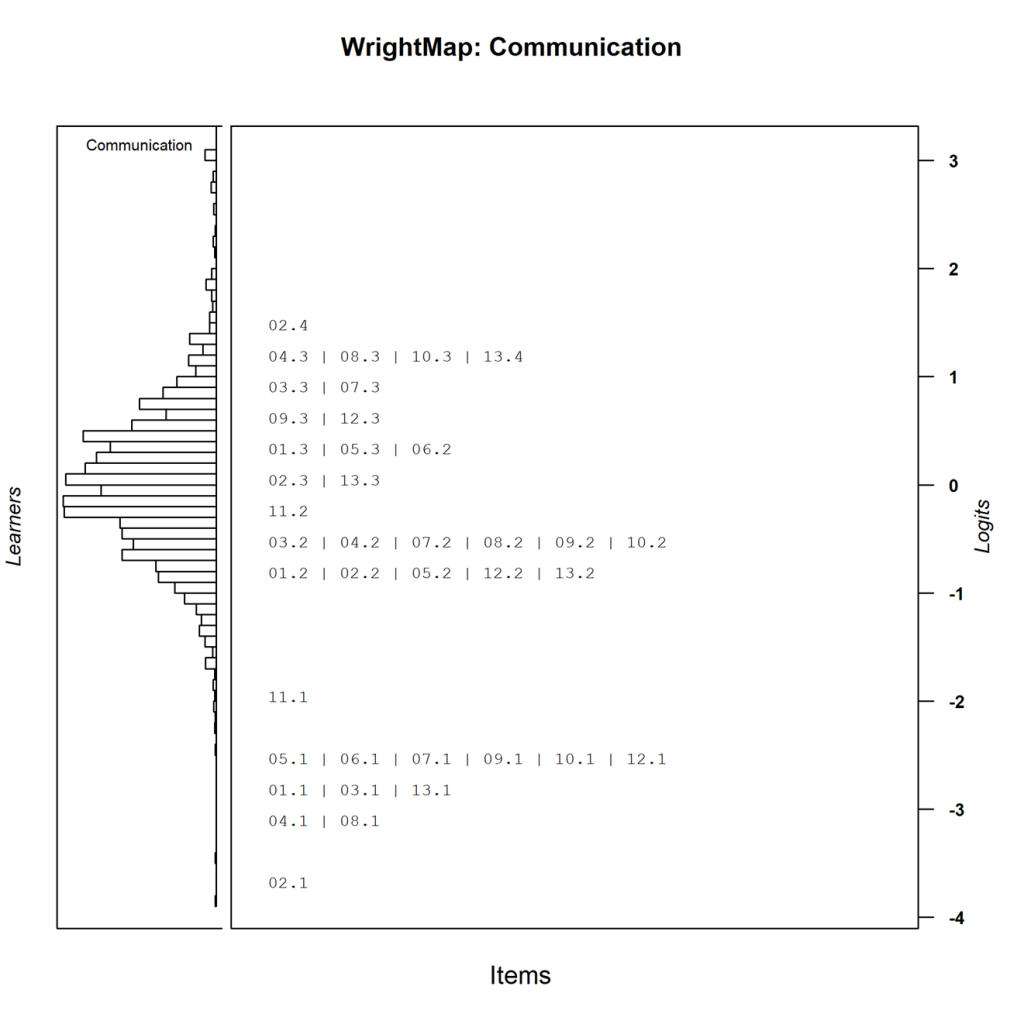
Analysis via Wright maps revealed that while the assessment included many skills identified as easy to perform, a good number of ALS learners were performing at higher, more challenging levels.
Learner progressions
The foregoing findings provided empirical verification of developmental progressions for the four assessed capabilities. By grouping assessment questions by difficulty, clear performance levels were identified that represent a significant shift in a learner’s ability.
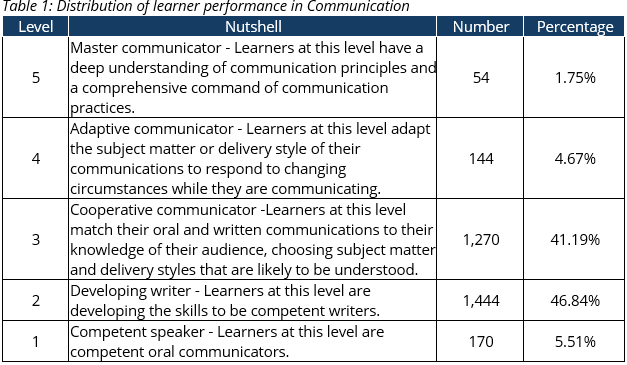
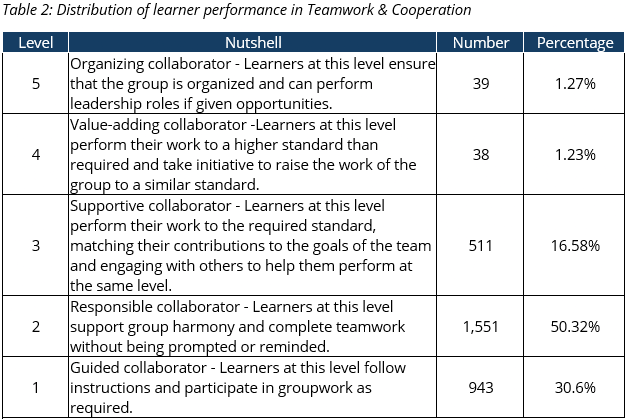
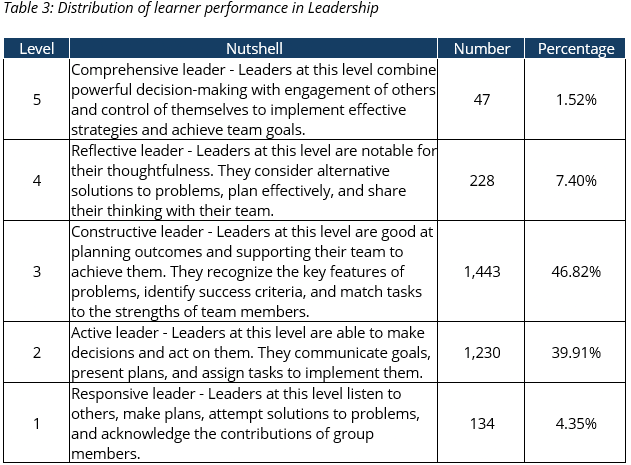
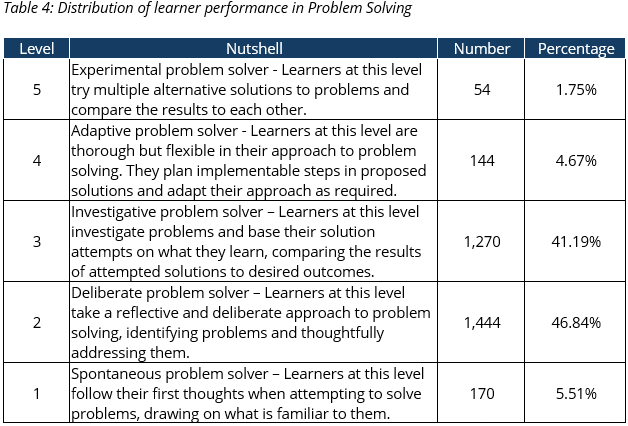
The quality criteria of the items were ordered by difficulty and then themes were identified, indicating levels of qualitatively different performance. Cut-points in the data, representing significant shifts in learner performance, were identified to separate the levels. The themes and levels identified in the results for the four capabilities are shown in the progressions. The text at the beginning of each description is a ‘nutshell’ statement that can be used to provide a quick shorthand for what a learner can do at that level. These statements are shown in Tables 1 to 4. The levels are cumulative, i.e., they build on one another. Once learners can perform the skills at a particular level, it is understood that they can perform all the skills below that level.
Distributions of learner performance
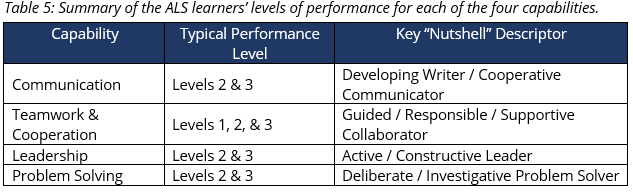
Also shown in Tables 1 to 4 are the overall numbers and percentages of learners who performed at the different levels of the progressions. The bulk of learners were found to be performing at Levels 2 and 3 in all the capabilities except Teamwork and Cooperation, where the bulk was distributed between Levels 1, 2 and 3. Table 5 shows a summary of the bulk of the ALS learners levels of performance for each of the four capabilities.
Insights
The focus on capacity building ensured that those responsible for putting the ALS program into implementation fully understand the thinking behind the assessment methods. When implementers understand the why behind the method, they are more likely to see its value for learners, leading to a much more successful rollout.
Conclusions and Recommendations
Conclusions
The research project successfully micro-certified over 2,800 ALS learners and built significant capacity within the DepEd-Bureau of Alternative Education (BAE). The psychometric analysis using the Rasch model confirmed that the assessment instruments are robust, reliable, and fair. These tools effectively differentiated learner performance levels, providing a different view of capability that traditional assessments often miss.
The following are key outcomes from the research:
BAE Readiness: DepEd-BAE specialists proved adept at implementing the assessment methodology for ALS Life Skills micro-certification.
Technological Success: Both teachers and learners preferred the Ruby online platform to paper-and-pencil methods, and it proved to be a cost-effective solution for large-scale assessment.
Proven Capability: The data showed that most ALS learners are already performing at Levels 2 and 3 in critical life skills, highlighting the immediate value of these certifications for employability.
Strategic Implementation: It was important to ensure that implementers understood the “why” behind the methodology, which fosters trust in the methodology, the assessment tools, and their long-term adoption.
Recommendations
To ensure the successful national expansion of the micro-certification program, the following actions are recommended:
- Maintain Technical Partnerships: Establish a continuing relationship between Melbourne Metrics (for technical support) and DepEd-BAE (for delivery) to ensure high assessment standards.
- Adopt the Ruby Platform: Fully adopt the Ruby platform for life skills assessment while maintaining a paper-and-pencil option for raters who may face technical access issues.
- Automate Performance Checks: Utilize Ruby’s automated performance leveling while continuing to conduct periodic psychometric checks to ensure ongoing quality control.
- Promote Learner Agency: Continue using learner self-assessment as a tool to help learners track their own development and build confidence in their capabilities.
- Expand Targeted Research: Conduct further research into specific demographic groups that may perform at lower levels of the progression to ensure the program remains inclusive.
- Launch Advocacy Alliances: Scale up advocacy campaigns involving employers and local governments to increase public awareness and industry acceptance of ALS micro-certifications.