Data Science for Public Policy Program (DSPPP) Conducted the 2026 Basic Bootcamp on “Explainable AI” to Safeguard Transparency in Philippine Governance
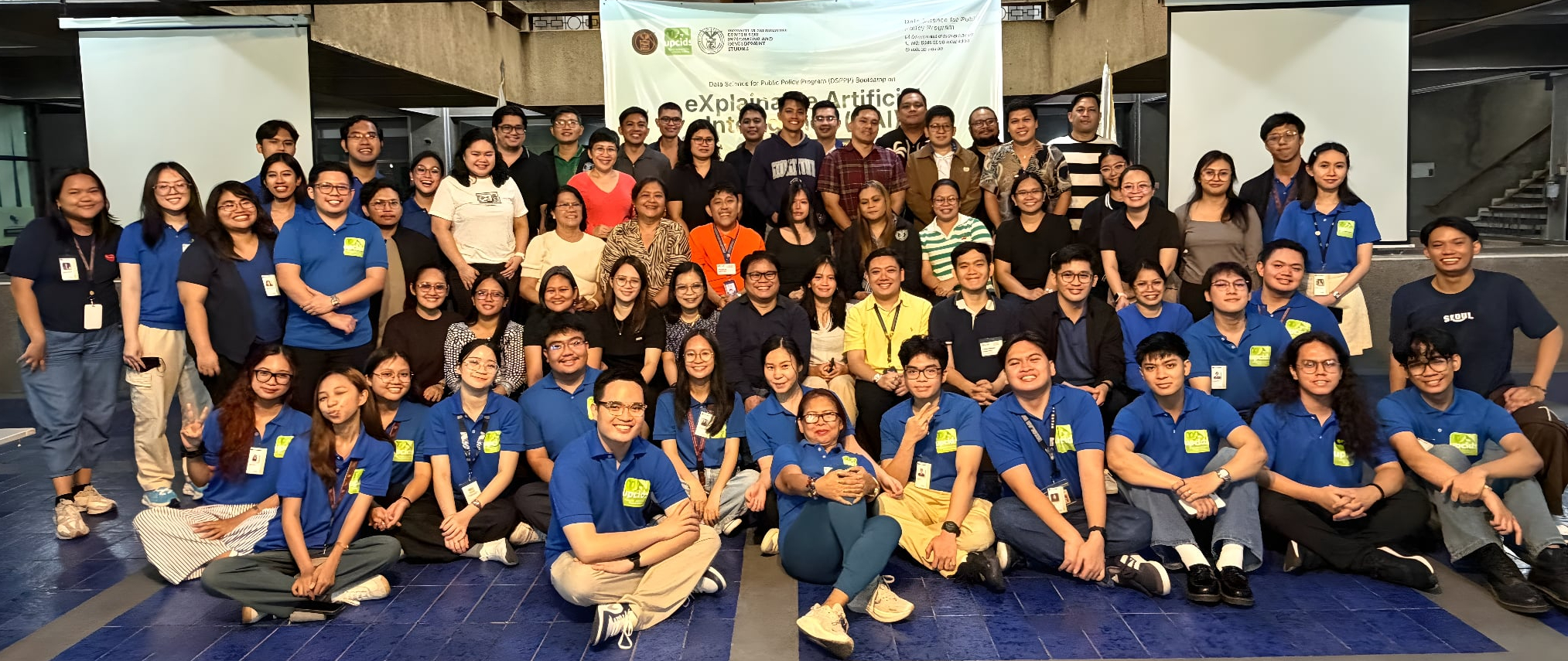
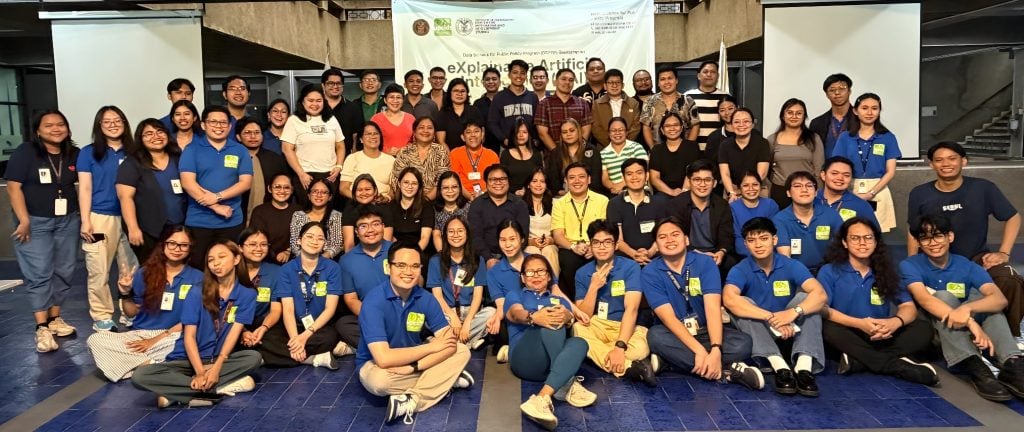
QUEZON CITY, PHILIPPINES – June 26, 2026 – The University of the Philippines Center for Integrative and Development Studies (UP CIDS), through its Program on Data Science for Public Policy (DSPPP), successfully concluded its five-day Basic Bootcamp on “Explainable Artificial Intelligence for Public Policy” (XAI4PP) held from 22 to 26 June, 2026 at the UP Institute for Small-Scale Industries (ISSI). The intensive training gathered a total of 43 participants composed of thirteen (13) researchers and professors from UP constituent units, as well as, thirty (30) representatives from various government agencies, including the House of Representatives, Philippine Statistics Authority, the Bureau of the Treasury, the Anti-Red Tape Authority, the National Telecommunications Commission, the Department of Education, the Insurance Commission, the Bangko Sentral ng Pilipinas, and the Anti-Money Laundering Council. Aside from the UP faculty and research personnel, academics from other universities such as the Far Eastern University in Alabang, Northeastern Mindanao State University, and the Northwestern University in Laoag City also participated.
As the first of a three-level capacity-building series, this year’s bootcamp centered on a critical principle for modern governance: “AI-informed, human-directed.” DSPPP Convenor and Bootcamp Project Leader, Dr. Ebinezer Florano, emphasized that artificial intelligence must serve the public good without sacrificing accountability. He stated that “We aim for a ‘white box’ rather than a ‘black box’ approach…AI decisions in government must be transparent, auditable, and maintain human accountability, especially in high-risk sectors like healthcare and transportation.” This statement was advocated by Dr. Florano during the House of Representatives ICT Committee Technical Working Group on the proposed AI Development and Regulation Act.
The bootcamp provided a comprehensive technical pathway. Participants were engaged in rigorous hands-on exercises covering data preparation and visualization using Python (Google Colab) and Google Data Studio. The bootcamp also introduced low-code/no-code platforms such as KNIME and Orange Data Mining for machine learning and Natural Language Processing (NLP). Prof. Jonathan Mamplata from UP Los Baños’ Institute of Mathematics taught these highly technical lessons. The participants were ably guided by training assistants in learning the technicalities of Data Science. Capping the bootcamp on the last day, Dr. Florano shifted the focus to policy writing, featuring an introduction to SPARK (Structure Policy Analysis and Research Knowledge), a guidance-only AI mentor developed to assist government personnel in drafting evidence-based policy briefs.
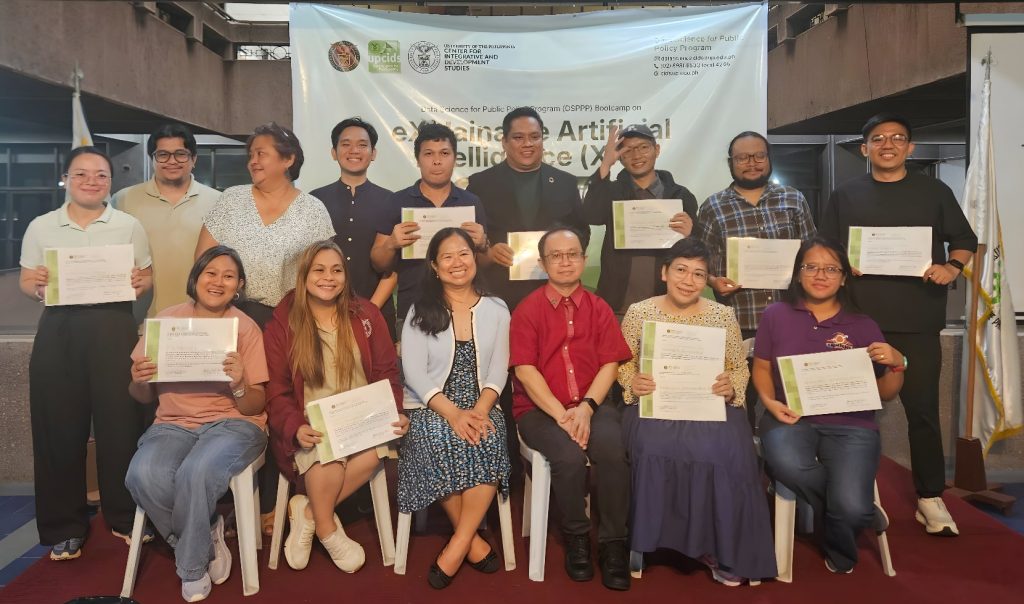
UP CIDS Executive Director Dr. Rosalie Arcala Hall welcomed the participants and congratulated them during the graduation ceremony. Dr. Hall highlighted the DSPPP’s expanding mission, noting plans to increase participation from various government units to bridge technological gaps across the public sector.
Pre- and Post-Training Diagnostic Quiz and Self-Assessment were administered among the participants. Their post-training scores are significantly greater than their pre-training scores. Moreover, among the 30 respondents, 20 (66.7%) improved their quiz scores from pre- to post-training. The results provide strong statistical evidence that the 2026 Basic Bootcamp significantly improved participants’ knowledge and understanding of the topics covered. The long quiz assessment complements the pre- and post-tests confidence findings that were reported separately. The confidence report based on the pre- and post-tests demonstrated a substantial shift in self-perception (mean gain of +1.40), while the long quiz results confirm that objective knowledge gains were achieved. Overall findings show that the basic bootcamp significantly increased the knowledge and skills of the participants on XAI application to public policy making.