Securing a Shared Maritime Space: Highlights from the Forum on Maritime Security and Regional Governance in the Sulu-Sulawesi Maritime Corridor
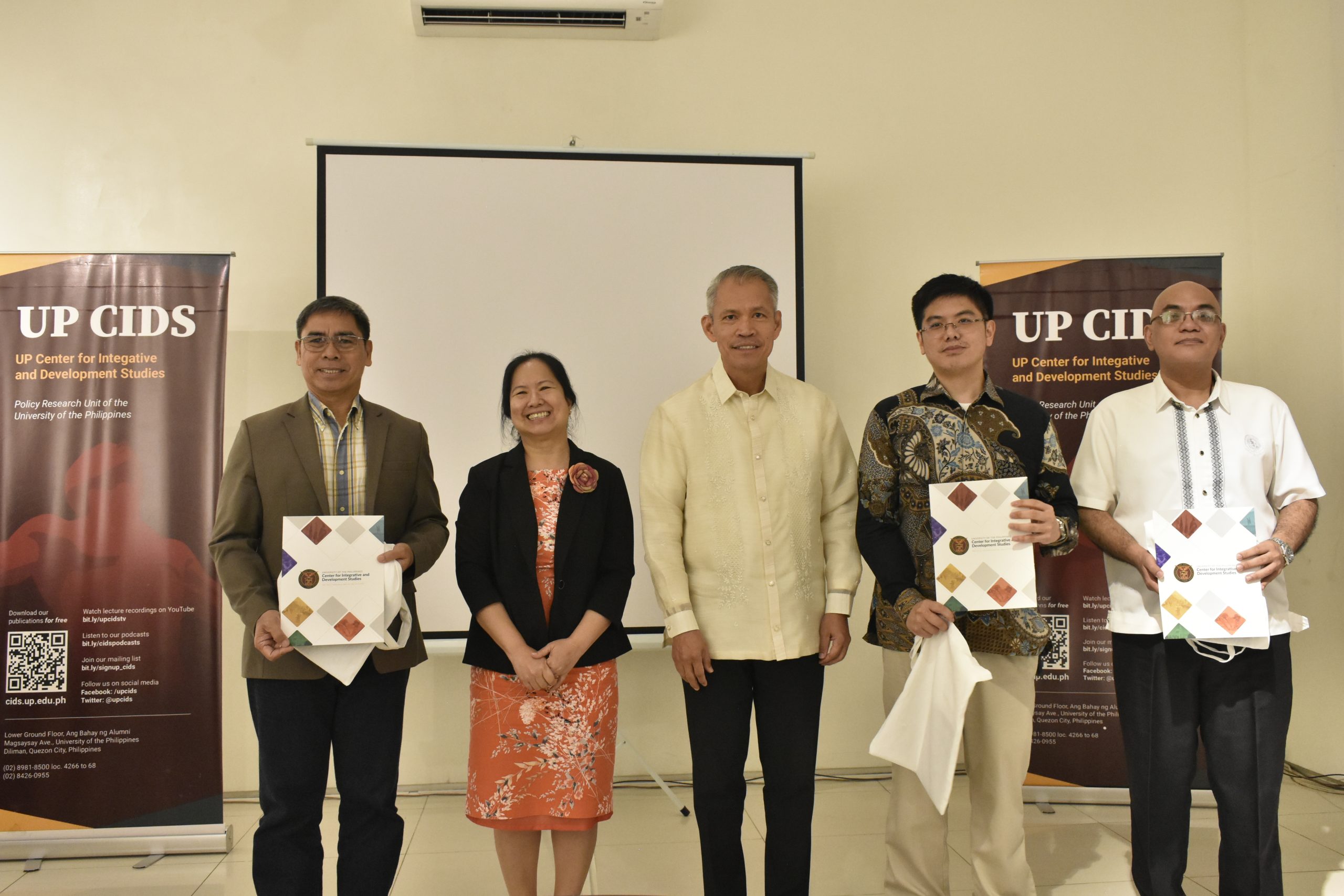
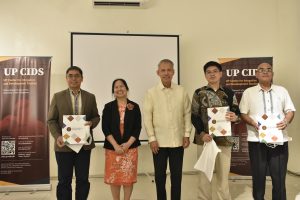
On October 1, 2026, the University of the Philippines Center for Integrative and Development Studies (UP CIDS), in collaboration with the Department of Foreign Affairs–Foreign Service Institute (DFA-FSI), convened the Forum on Maritime Security and Regional Governance in the Sulu-Sulawesi Maritime Corridor at the ASEAN and Japan Hall of the GT-Toyota Asian Cultural Center, University of the Philippines Diliman.
The forum brought together policymakers, law enforcement and security authorities, and legal practitioners and scholars to examine maritime security and governance challenges from strategic, legal, and developmental perspectives. Dr. Rosalie Arcala Hall, Executive Director of UP CIDS, delivered the opening remarks, followed by a welcome address from Dr. Dave Centeno, Assistant Vice President for Research and Innovation.
Atty. Marco Angelo Felix L. Lopez, Director of the Ocean Governance, Shipping, and Seafaring Division of the Department of Foreign Affairs’ Maritime and Ocean Affairs Office, opened the presentations with “Marine Scientific Research (MSR) under the United Nations Convention on the Law of the Sea (UNCLOS) and Its Applicability in the Sulu-Sulawesi Corridor.” He discussed the UNCLOS framework governing marine scientific research and explored provisions that could support an updated framework for foreign-assisted research and scientific cooperation in the corridor.
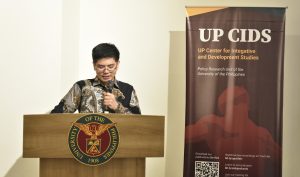
Next, Director Romeo T. Racadio of the National Security Council’s Special Concerns Office delivered “From Maritime Frontier to Shared Corridor: Maritime Security, Regional Governance and Resilience in the Sulu-Sulawesi Seas; Lessons from Tawi-Tawi at the Sulu-Sulawesi Maritime Crossroads.” Using Tawi-Tawi as a lens for understanding broader maritime governance challenges, he examined geographic isolation, cross-border mobility, security threats, and emerging strategic risks. He emphasized the need to move beyond securing remote maritime frontiers toward governing an interconnected corridor and proposed a Secure–Connect–Formalize–Develop–Partner framework to strengthen regional cooperation, community resilience, and national interests.

Following a brief mid-morning break, Mr. Georgi Engelbrecht, Senior Analyst at the International Crisis Group, delivered “Challenges and Opportunities for the Internal Security–Territorial Defence Nexus in the Sulu Sea” through a video presentation. Drawing on his work on internal security in the Bangsamoro region, he examined its intersections with national security and maritime concerns, particularly in light of recent elections in the Bangsamoro Autonomous Region in Muslim Mindanao (BARMM).
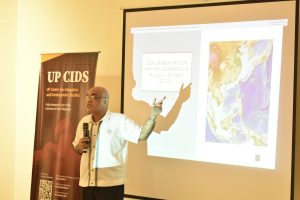
The presentations concluded with “Legal Frameworks for the Maritime Governance of Sulu-Sulawesi,” delivered by Mr. Neil Simon S. Silva, Legal Officer at the Institute for Maritime Affairs and Law of the Sea (IMLOS) of the UP Law Center. He discussed legal frameworks governing maritime jurisdiction, passage rights under UNCLOS, and maritime crimes under Philippine law. He also examined BARMM’s territorial jurisdiction over its waters and regional cooperation mechanisms for addressing maritime crime, including the ASEAN Convention on Counter Terrorism and the ASEAN Treaty on Mutual Legal Assistance in Criminal Matters.
A question-and-answer session with the audience, moderated by Asst. Prof. Nathaniel P. Candelaria of the UP Diliman Department of Political Science followed. The forum concluded with remarks from Hon. Mr. Neil Frank R. Ferrer, Director General of the DFA-FSI, and a networking lunch.
The forum addressed persistent maritime challenges, including fuel smuggling, contraband trafficking, and other illicit cross-border activities that affect border security, local economic governance, and regional trust. Discussions also highlighted jurisdictional coordination, community-based security, and maritime livelihoods. By bringing together expertise in diplomacy, national security, and maritime law, the forum underscored the importance of integrated, evidence-based policies that balance security with regional cooperation, sustainable development, and the resilience of maritime communities.