Strengthening Flexible Learning: UPOU’s Digital Transformation Project Leads Brown Bag Session
By: Marie Lara Pauline B. Bobier, LPT, MAMS
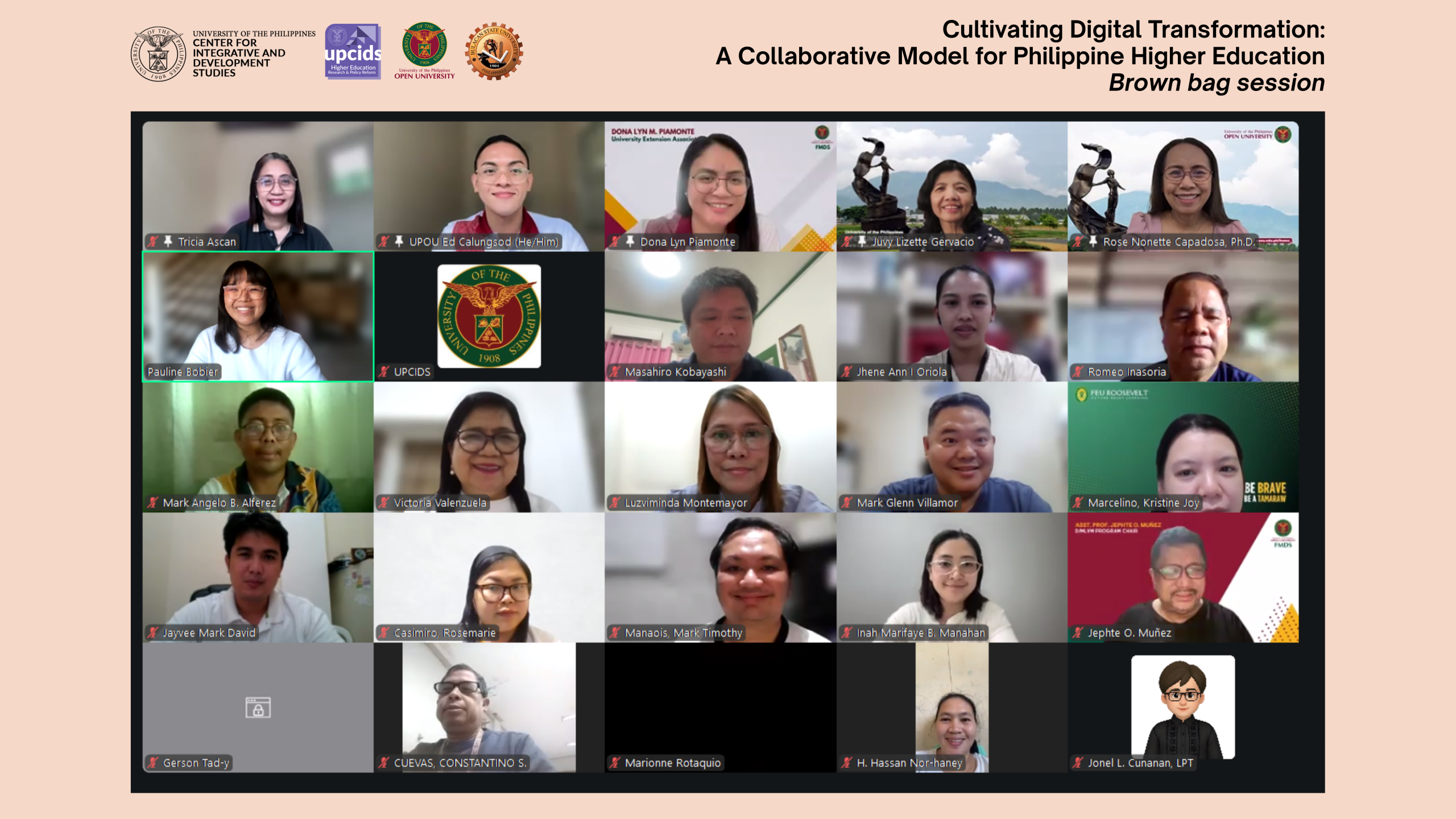
The Faculty of Management and Development Studies (FMDS) of the University of the Philippines Open University (UPOU), in partnership with the Higher Education Research and Policy Reform Program (HERPRP) of the University of the Philippines Center for Integrative and Development Studies (UP CIDS) and the Bulacan State University (BulSU), held its second event for the Digital Transformation Project on September 11 via Zoom.
Educators, researchers, students, and partners from BulSU attended the online session, where the UPOU scholars gave an initial update on their research project.
Project leader Assoc. Prof. Juvy Lizette M. Gervacio, PhD, presented emerging findings from the workshop held last June at BulSU, emphasizing that digital transformation extends beyond adopting technology and involves changes in how learning is designed, accessed, and supported. Findings from the collaboration show that while BulSU faculty already demonstrate relatively high digital readiness and experience with blended learning, challenges in internet connectivity, devices, ICT infrastructure, and the absence of a permanent learning management system continue to affect implementation. The study consequently positions sustainable digital transformation as a shared institutional effort that brings together leadership, faculty, students, and external partners, supported by appropriate policies, infrastructure, continuous training, partnerships, and sustainable funding.
Asst. Prof. Rose Nonette C. Capadosa, PhD, discussed Reimagining Course Design for Flexible Higher Education, which examines how higher education institutions can design learning experiences that respond to the growing demand for lifelong and flexible learning. The study explores the strengths, challenges, and practices of a provincial state university as it works toward a learning design framework covering formal, nonformal, and informal learning. Assoc. Prof. Capadosa situated the research within recent developments in lifelong learning and microcredentials, highlighting the importance of digitally mediated, competency-based, asynchronous, and flexible learning pathways that remain aligned with academic standards. The research also considers how higher education can respond to geographically dispersed learners and evolving workforce needs while strengthening institutional approaches to learning design.
Asst. Prof. Edmerson Z. Calungsod, MA, presented Beyond Multiple Choice: Faculty Capacity for Assessment in ODeL, highlighting the need to rethink assessment as digital learning and generative artificial intelligence reshape how evidence of learning is produced and evaluated. Initial findings show that faculty members are already moving beyond conventional examinations by using multimodal, collaborative, reflective, and performance-based assessments. However, academic integrity, authentic assessment, instructional design, and effective AI use remain important areas for capacity development. Asst. Prof. Calungsod emphasized a shift from simply evaluating final outputs toward designing multiple forms of evidence that make the learning process visible through contextualized tasks, drafts, reflection, oral explanation, and revision. The study further stresses that credible and inclusive ODeL assessment requires faculty development to advance alongside institutional investments in infrastructure, instructional design, policy, and learner support.
Asst. Prof. Tricia C. Ascan, MA, presented From Access to Transformation: Localizing Open Educational Resources in Philippine Higher Education, examining how Open Educational Resources (OERs) can contribute to more accessible and responsive teaching and learning. The study emphasizes that making educational resources openly available is only one component of transformation. OERs must also be meaningfully integrated, adapted, and localized according to specific teaching and learning contexts. Initial findings identify OERs as potential instruments for access, affordability, and inclusion, while also pointing to technological and infrastructure barriers, the need for institutional policies and quality assurance, and continued faculty capacity building. These findings frame OER adoption as an institutional ecosystem issue and provide the foundation for developing a framework for the sustainable localization and integration of OERs in Philippine higher education.
Ms. Dona Lyn M. Piamonte shared Participatory Communication in OER Development and Collaborative Learning Design, discussing the role of dialogue and stakeholder participation in digital transformation. Rather than designing learning environments solely for stakeholders, the study explores how institutions can design with faculty members, students, communities, industry partners, government, and technical teams through co-creation, feedback, and shared decision-making. Initial findings indicate that respondents place strong importance on collaboration and participatory communication, while barriers involving technology, time, resources, and institutional support continue to constrain meaningful participation. The emerging model therefore places dialogue, co-creation, feedback, and refinement at the center of the learning design process, recognizing that sustainable digital transformation requires not only technological capacity but also institutional mechanisms that enable different stakeholders to contribute their knowledge and experiences.
The Digital Transformation Symposium will be held on Thursday, November 19, 2026, at 8:30 AM, via Zoom and face-to-face at the UPOU headquarters in Los Baños, Laguna. Register here: https://forms.gle/gozQtXa9wpTof7569. Admission is free.