Animal bites as a public health and governance concern
Animal bites are a rising public health and governance concern in Baguio City and the neighboring municipality of La Trinidad, Benguet. Despite the Anti-Rabies Act of 2007 (RA 9482), the National Rabies Prevention and Control Program (NRPCP), PhilHealth’s Animal Bite Treatment (ABT) package, and regional surveillance efforts (e.g., CAR: Integrated Bite Case Management System), local bite incidence continues to increase, disproportionately affecting children and low-income households. Because rabies is nearly 100% fatal once symptomatic, prevention, rapid post-exposure care, and evidence-informed policy are imperative.
The Animal bite risk reduction in the Cordillera: The Case of Baguio City and La Trinidad, Benguet Project tackles data on animal bites using case records from participating Animal Bite Treatment Centers (ABTCs), veterinary vaccination and sterilization data, and environmental indicators to generate actionable evidence on hotspots, seasonal risk, vulnerable populations, and service gaps.
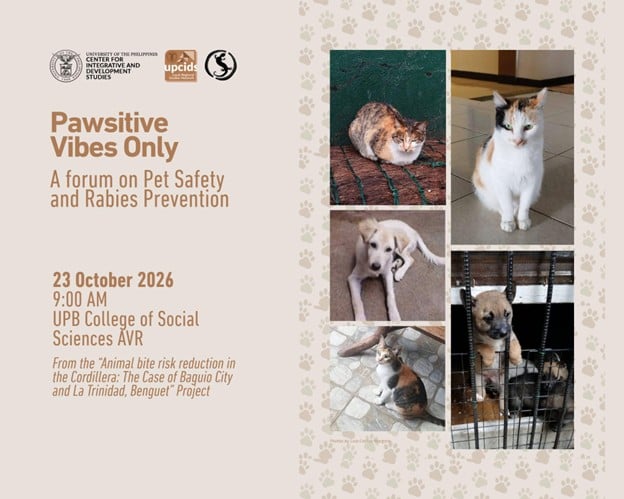
Pawsitive Vibes Only: A forum on Pet Safety and Rabies Prevention
The project proponents headed by Prof. Rizavel Addawe will be unveiling its real-time animal bites database. The database integrates case records from participating Animal Bite Treatment Centers (ABTCs), veterinary vaccination and sterilization data, and environmental indicators. This can then be used to generate actionable evidence on hotspots, seasonal risk, vulnerable populations, and service gaps.
A forum with experts from the City Health Services Office and the UPB Cats volunteers discussing pet safety and rabies prevention will be conducted as an immediate response to the need for more information dissemination on animal bites. The forum will be moderated by Asst. Prof. Jasmin Bayquen
Who should attend this forum?
The forum is open to the public.
The public forum is presented by the UP Center for Integrative and Development Studies and the UP Baguio Cordillera Studies Center.
Contact Person:
Prof Rizavel C Addawe
Project Leader
[email protected]