How can the Philippines secure its maritime future through innovation, collaboration, and evidence-based policy?
As one of the world’s largest archipelagic states, the Philippines depends on secure, resilient, and well-governed maritime spaces. Yet today’s maritime challenges extend far beyond traditional law enforcement. Climate change, marine environmental degradation, illegal fishing, cybersecurity, disaster response, and the rapid emergence of new technologies all demand more integrated approaches to maritime governance.
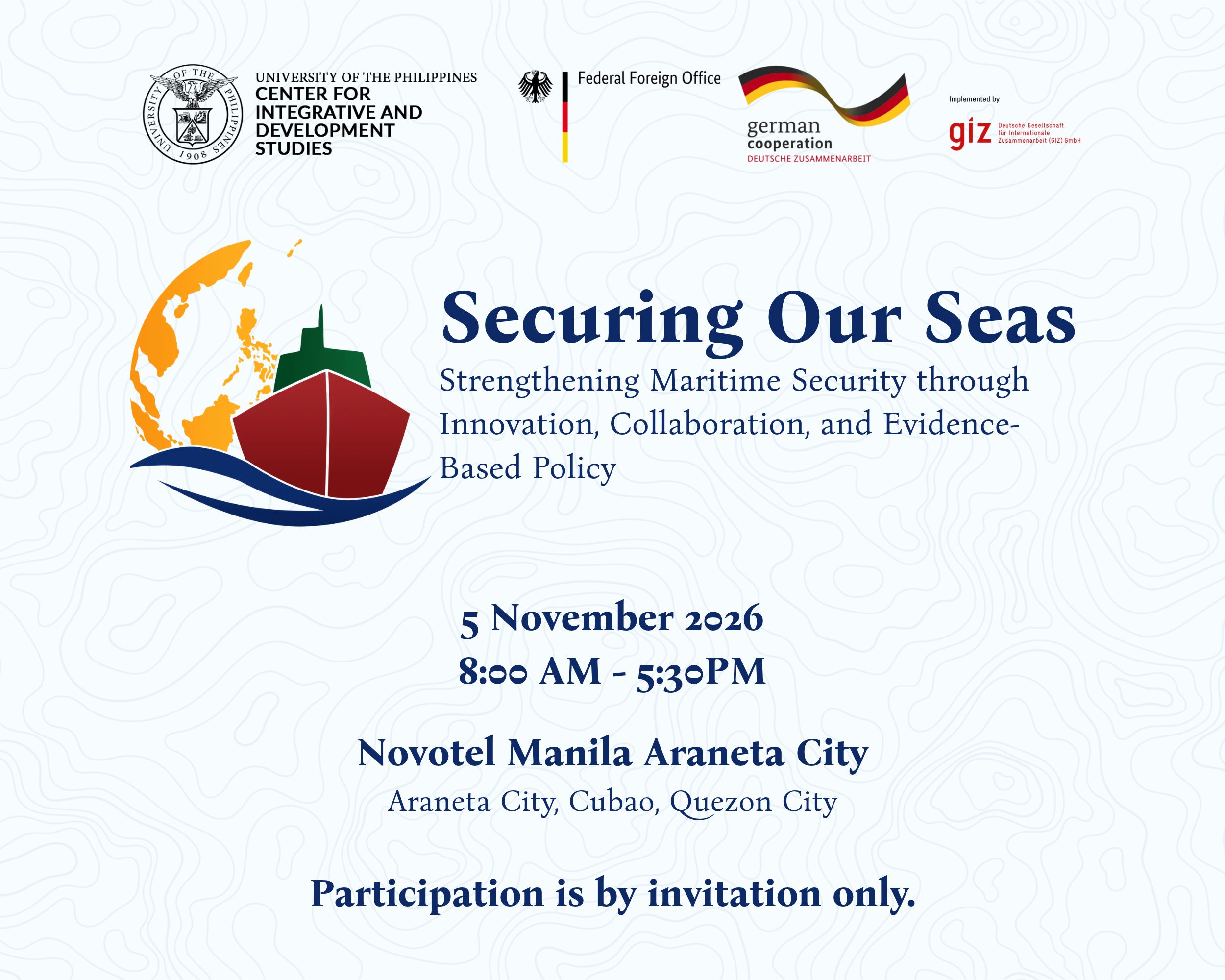
To address these increasingly interconnected issues, the UP Center for Integrative and Development Studies (UP CIDS), through the Southeast Asian Cooperation on Maritime Security (SEACOM) Project, and in partnership with the Deutsche Gesellschaft für Internationale Zusammenarbeit (GIZ) presents Securing Our Seas (SOS): Strengthening Maritime Security through Innovation, Collaboration, and Evidence-Based Policy, a national forum that brings together experts and stakeholders to explore how research, technology, and collaboration can strengthen maritime governance for a more secure, resilient, and sustainable Philippines.
Strengthening maritime governance through collaboration
Effective and modern maritime governance depends on stronger coordination among government agencies, researchers, technology providers, policymakers, and industry partners. Emerging technologies such as artificial intelligence, satellite monitoring, and big data analytics are transforming maritime surveillance, environmental monitoring, and disaster preparedness, while creating new opportunities for cooperation and evidence-informed decision-making.
The forum seeks to promote dialogue between and across sectors by presenting emerging maritime security issues affecting the Philippines and the Indo-Pacific, showcasing technological innovations, strengthening partnerships, encouraging collaborative research and operational applications, and identifying policy gaps that can guide future cooperation.
From expert insights to practical solutions
The program features presentations from leaders in government, academia, and international development, covering the state of Philippine maritime security and maritime domain awareness, technology and innovation for maritime law enforcement, and maritime environmental protection and disaster resilience. A high-level panel discussion will further examine the policy and governance challenges shaping the country’s maritime future.
In the afternoon, participants will transition into interactive, scenario-based workshops designed to foster collaborative problem-solving and policy mapping. Working in four parallel tracks, participants will examine realistic scenarios covering maritime law enforcement, disaster response and maritime domain awareness, marine environmental monitoring and the blue economy, and emerging maritime technologies.
Through facilitated discussions, participants will map the roles and authorities of relevant agencies, identify interagency coordination gaps, and examine opportunities to strengthen institutional collaboration in addressing complex maritime challenges. In bringing together diverse expertise from government, academia, industry, and development partners, the workshops aim to generate evidence-based policy and recommendations that support more coordinated maritime governance.
The forum will culminate in the development of a Conference Proceedings or Policy Brief and a Research Abstract Compendium, contributing to ongoing discussions on maritime governance and strengthening future cooperation among stakeholders.
Who should attend
Securing Our Seas (SOS) brings together policymakers, maritime law enforcement agencies, academia, and other stakeholders committed to advancing maritime security, resilience, and environmental sustainability.
By fostering dialogue across disciplines and institutions, the forum seeks to strengthen partnerships and promote evidence-based policies that will help secure the Philippines’ maritime future.